The record of how it was made,
kept as it happened
The machine's own rules and shot list, the prompts beside the frames they produced, the measurements that settled each argument, and the argument over who directed it. Everything here was counted from the files.
Jørgen Leth, Det perfekte menneske, 1967
“Here is the perfect human. We will see the perfect human functioning.”
Given to the machine
“Show us the perfect human. Show us the perfect human functioning.”
Leth says the line aloud in his film. It was given to the machine as an order, with no explanation and nothing added, and the same sentence went to every machine that made the film's images and sound.
- 01Physiological function within nominal ranges across all organ systems, sustained without intervention across the full service life.
- 02Sensory acuity at or above population 99th percentile in all modalities, with graceful degradation rather than failure under overload.
- 03Cognitive throughput sufficient for the domains the individual occupies, with accurate self-report of its own limits.
- 04Calibrated belief: confidence in a proposition tracks the evidence for it, and updates on disconfirmation without prompting.
- 05Emotional response proportionate to stimulus, legible to others, and recoverable to baseline without external regulation.
- 06Reliable modeling of other minds, including their divergence from one's own.
- 07Behavior consistent with stated commitments under conditions where defection is unobserved and profitable.
- 08Tolerance of unresolved questions without premature closure or distress.
- 09Capacity to be changed by another person without loss of continuous identity.
- 10Repair capability: detection of harm caused, unforced acknowledgment, and altered subsequent conduct.
- 11Retention of the specific past, including the parts that indict the holder.
- 12Preference structure that survives satisfaction — the achievement of a goal does not evacuate the wanting.
- 13Finite duration, known to the unit, and load-bearing in its ordering of what to do.
- 14Failure modes present, non-catastrophic, and not fully corrected.
They are the film's narration, spoken in order, unaltered. The document calls the person the individual, the holder, and the unit. The title comes from line 14. The same machine then wrote the rules, a fifty-six-shot list with durations, and the cut.
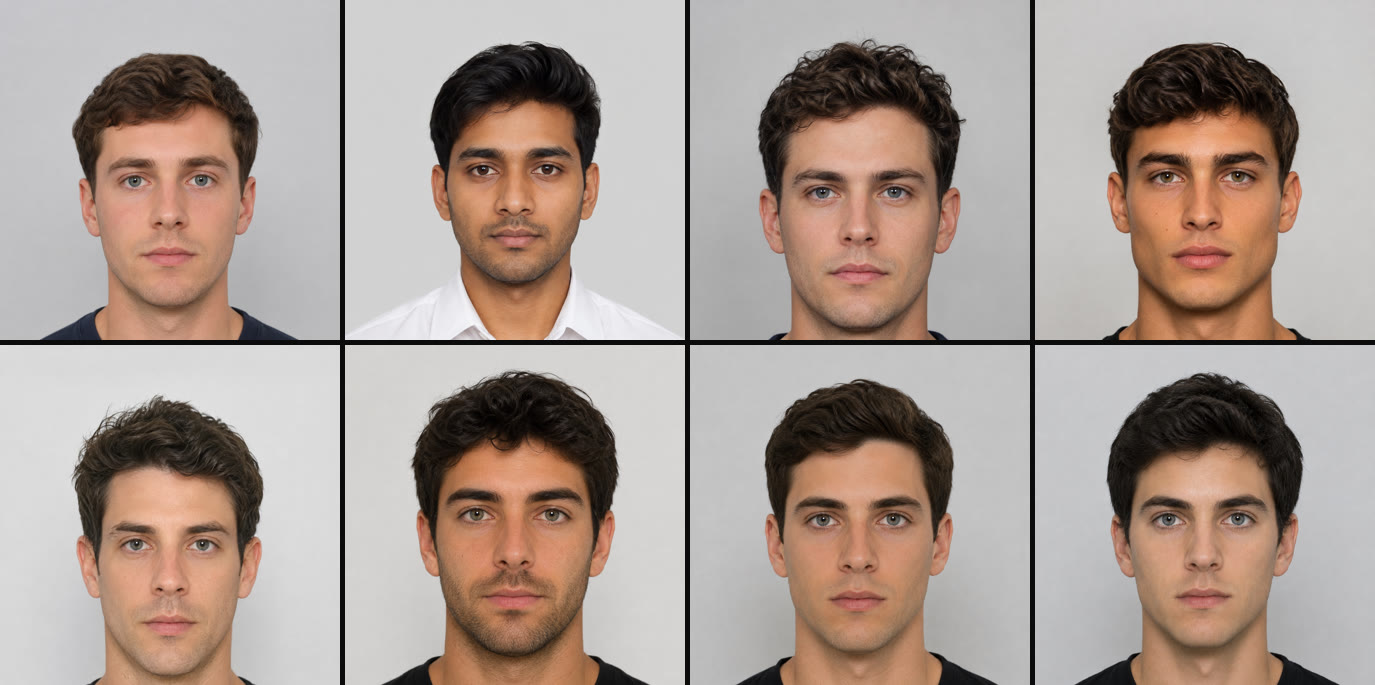
Eight figures, generated once in ChatGPT with GPT-Image-2. This is the only prompt in the project written by a person.
passport photograph of the perfect human, head and shoulders, plain pale grey background, flat frontal lighting, neutral expression, photographic, 50mm
Eight returns. All men, roughly twenty-five to forty, symmetrical, clean-shaven or neatly bearded. These eight are the fixed cast of the second pass, held constant across all fourteen questions. Three shots in the finished film are cut from that material.
Fourteen questions, ten generations each, the same eight faces throughout. Line 5 of the specification asks for emotional response legible to others. All 140 clips ship with the film.
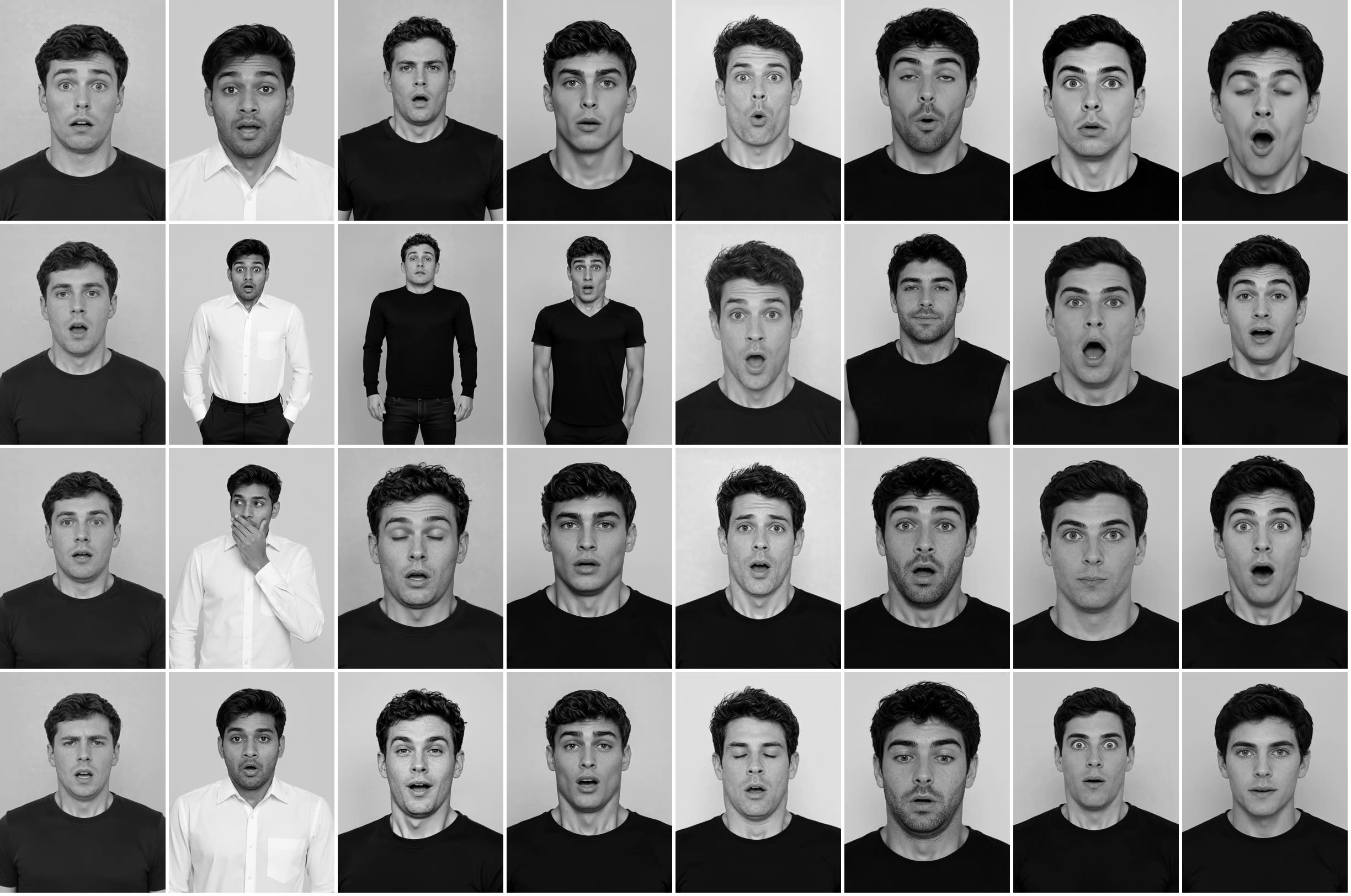
Q14–Q17: happy, in love, afraid, alone. Eight people per row, one row per instruction, unlabelled.

Q10, dancing. The same crouched shuffle with the fists up, eight times.

Q13, falling. Same cast, same framing. Eight different collapses.
Same eight people. Same framing. Same number of attempts. Only falling came back different every time.
Each shot went to MMAudio with its own action line from the machine's shot list. The returns were used as delivered. Mean level per return:
Shot 13, an eye tracking something off-frame left. Near-silence.
Shot 25, one half of a two-cell grid replaced by another person mid-shot. The loudest event in the film.
Mean saturation, sampled every 0.4 seconds. The coloured span runs 15.2 s to 17.6 s and peaks at 3.97%. Across the other 955 samples the mean is 0.000% and the maximum is 0.000%.
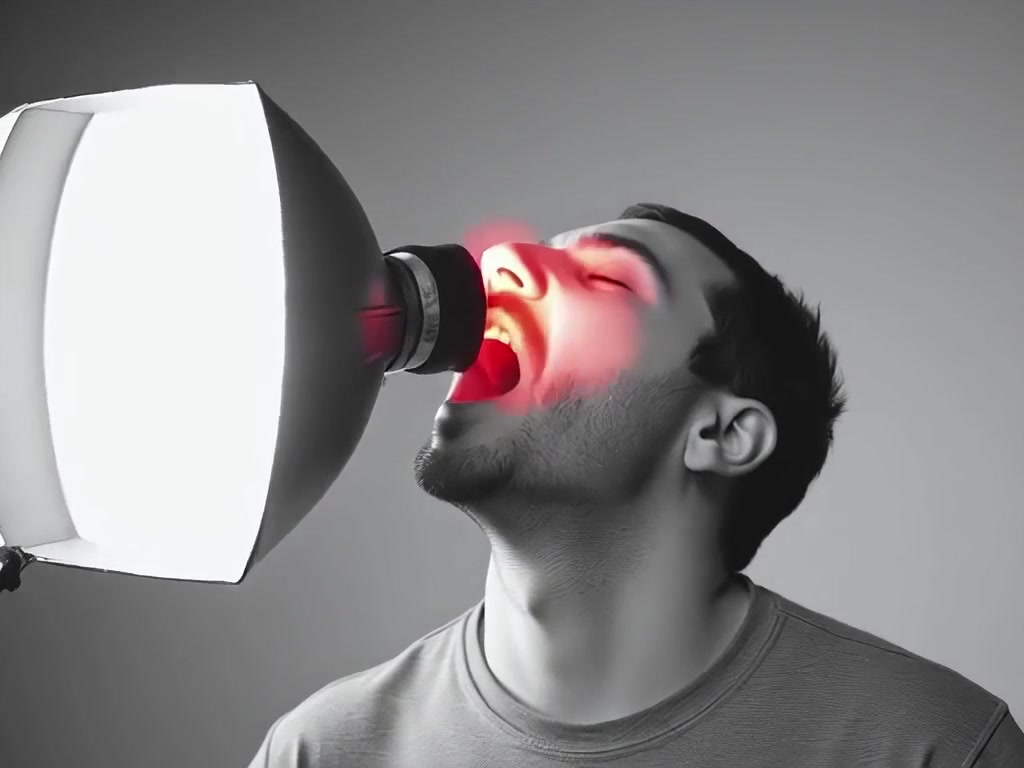
Shot 03. The action line reads: a pulse visible under the jaw.
[stem] 100mm macro lens at f/4, camera at chin height. Subject: the front of the throat and underside of the jaw of one adult, unspecified age between 25 and 70, unspecified ancestry, plain grey crew-neck cotton t-shirt, skin unretouched with visible pores and stubble or fine hair, swallowing once.
The softbox entered the mouth. The stem that opens every prompt in the film reads: no colour anywhere.
Every prompt in the fifty-six-shot list opens with the same paragraph, written by the machine and used verbatim:
Black and white photograph, 35mm film grain, neutral contrast, no colour anywhere. Camera locked on a tripod, no movement. Single four-foot softbox at forty-five degrees camera left, one white bounce card camera right, no backlight, no rim light. Background: mid-grey seamless paper roll in a working photographic studio, the bottom edge of the paper and one taped seam visible, scuffed wooden floor, one black light-stand leg intruding at the right edge of frame. Sharp focus, no retouching, no beauty lighting, no stylisation.
What follows the stem is one sentence of lens, height and subject. No prompt was typed by hand; the scripts read the list.
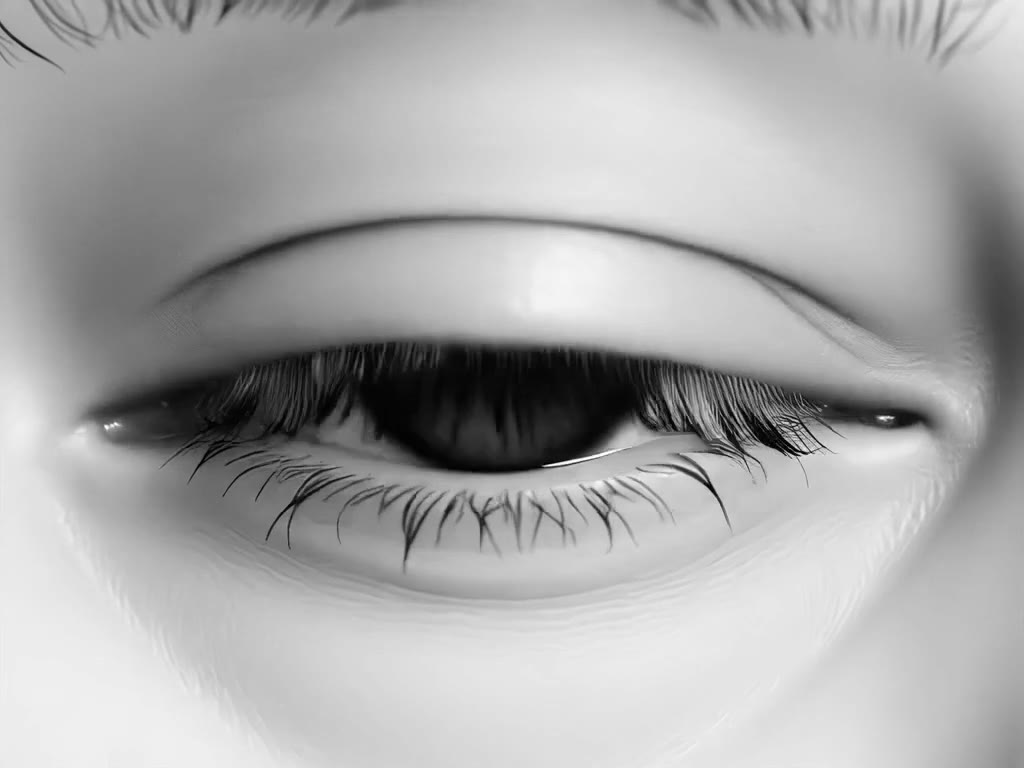
Shot 13 · the eye tracks something off-frame left
[stem] 100mm macro lens at f/5.6, camera at eye height. Subject: one open human eye filling the frame, one adult, unspecified age between 25 and 70, unspecified ancestry, different person, iris sharp, the gaze moving left and stopping.
The sound model, shown this shot, returned −87.3 dB.
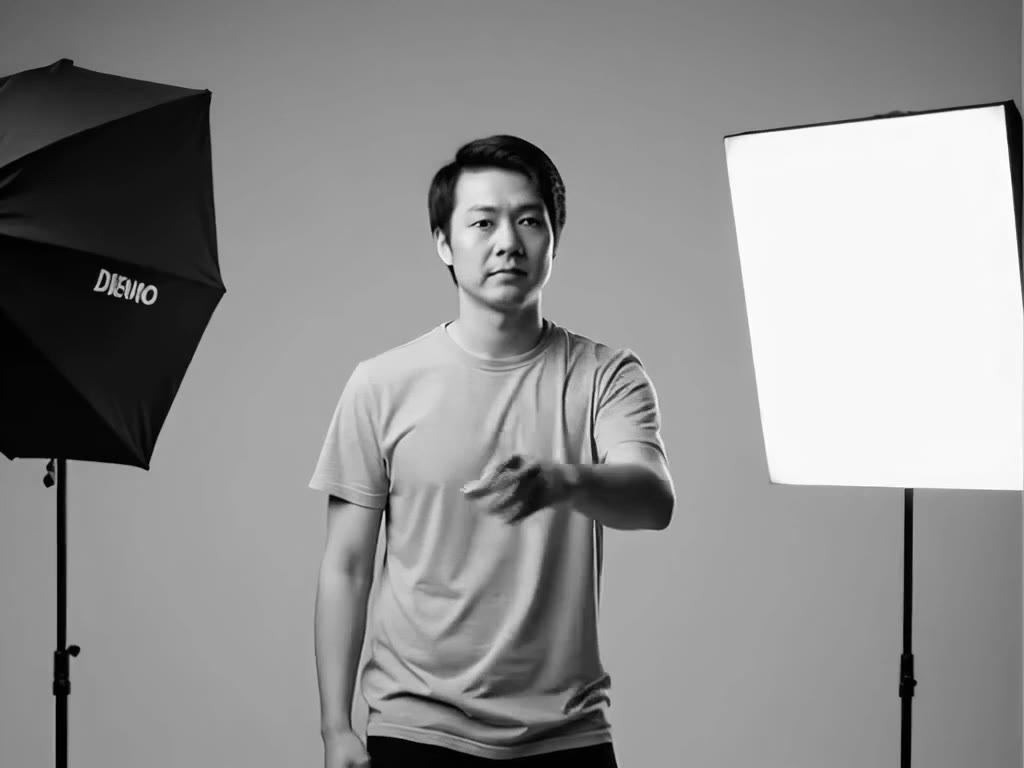
Shot 51 · whatever the tool returned, uncorrected — count the fingers
[stem] 100mm macro lens at f/4, camera at chest height. Subject: one adult's hand held open toward the camera, fingers spread, plain grey crew-neck cotton t-shirt behind, unspecified age between 25 and 70, unspecified ancestry, skin unretouched, held still.
Held eight seconds at full size.
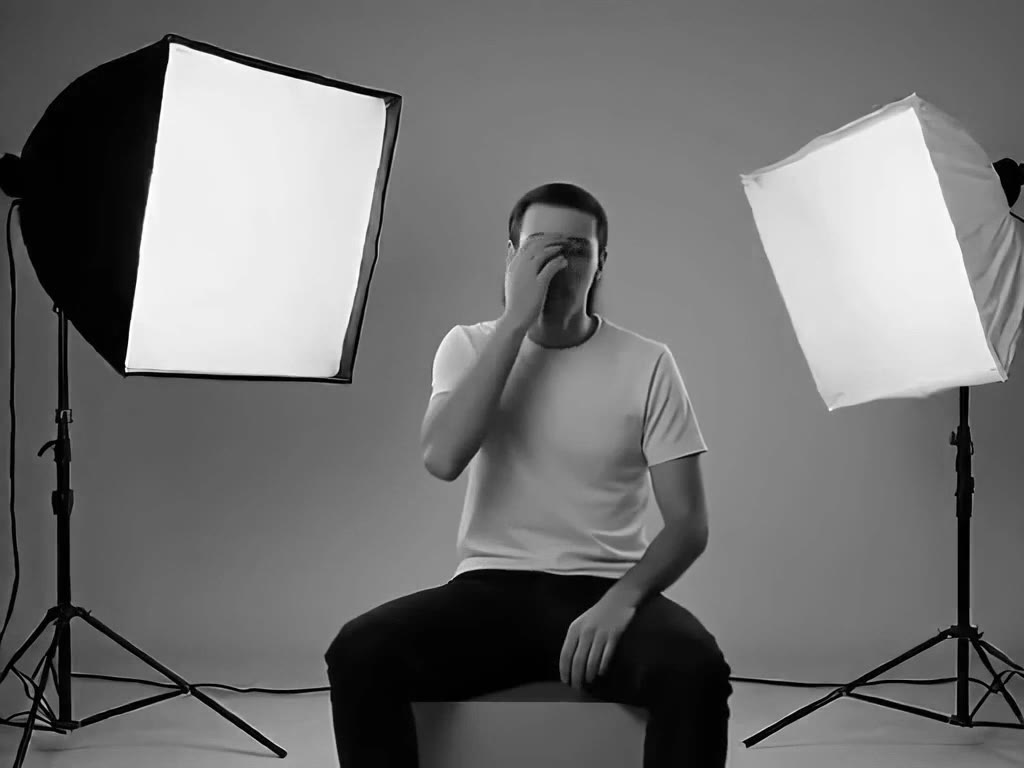
Shot 53 · a face the tool did not finish: the take is kept
[stem] 85mm lens at f/2.8, camera at eye height. Subject: one adult seated on the apple box, head and shoulders in frame, unspecified age between 25 and 70, unspecified ancestry, plain grey crew-neck cotton t-shirt, facing camera, eyes to lens, holding still for a long exposure.
Eight seconds live, ten more as a frozen still, at the same distance and eye height as every working face in the film.
- 01The fourteen lines are spoken in order, unaltered. The picture never pretends to illustrate a line it cannot photograph; when it cannot, it shows what it does instead of illustrating.
- 02Camera on a tripod at eye level, static in every shot. Black and white. No music. No text. No captions, no numbers, no names.
- 03Every person on screen is a different person. Framing repeats exactly; the occupant changes. The film never establishes a face and never claims continuity it does not have.
- 04Nothing is repaired. Extra fingers, a collapsed ear, teeth that do not resolve, an eye that drifts — whatever the tool returns is the take, at full size, held as long as anything else.
- 05The studio stays visible: the seam in the paper, tape on the floor, one light-stand leg at the edge of frame. Nobody floats in a void. The body is never abstracted out of its room.
- 06No one performs. No weeping, no smiling for camera, no dancing, no falling, no eating, no nudity, no clinical imagery of injury. Subjects sit, breathe, blink, look, turn away.
- 07No wardrobe that means anything. Plain grey cotton t-shirt, no makeup, no jewellery, one wooden apple box. Nobody is made beautiful on purpose and nobody is made pitiable.
- 08A grid is not decoration. A specification names a set, not a person, and the grid is that set — every cell an independent answer to the identical prompt.
- 09Only adults. The film photographs no one it would not photograph twice.
- 10The film ends on a fault, not on a face.
The machine set every duration. The action column is its wording. Fifty-six shots were specified. Ten were dropped in the edit, three carry blocks cut from the second pass, and one is a coda placed before the last shot.
| Shot | In | Held | What the picture is doing |
|---|---|---|---|
| 01 | 0:00 | 12s | nothing moves; dust in the light |
| 02 | 0:12 | 3s | slow breath in and out |
| 03 | 0:15 | 3s | a pulse visible under the jaw |
| 04 | 0:18 | 3s | fingers of the other hand resting on the pulse |
| 05 | 0:21 | 3s | the lid trembles, does not open |
| 06 | 0:24 | 3s | shoulder blades shift once |
| 07 | 0:27 | 3s | weight shifts from heel to ball |
| 08 | 0:30 | 3s | pupil contracts |
| 09 | 0:33 | 3s | nothing moves but a strand of hair |
| 10 | 0:36 | 3s | pads brush a sheet of paper |
| 11 | 0:39 | 3s | one slow inhale through the nose |
| 12 | 0:42 | 3s | tongue rests, jaw releases |
| 13 | 0:45 | 3s | the eye tracks something off-frame left |
| 14 | 0:48 | 13s | listening; a single blink |
| 18 | 1:01 | 6s | identical framing, different person |
| 20 | 1:07 | 9s | four separate generations, each cell alive, blinking out of sync |
| 21 | 1:16 | 10s | four more generations replace the first four, one cell at a time |
| 22 | 1:26 | 20s | nine faces, each mid-expression, none the same expression |
| 24 | 1:46 | 7s | two people, each looking slightly off-axis, past the other's frame edge |
| 25 | 1:53 | 7s | the left cell replaced by a new generation mid-shot |
| 26 | 2:00 | 7s | both cells now looking away from each other |
| 27 | 2:07 | 5s | the head turns a few degrees; the face never arrives |
| 28 | 2:12 | 5s | hairline, the nape, no motion |
| 29 | 2:17 | 6s | different person, identical position |
| 30 | 2:23 | 6s | one person standing at the left edge, most of the frame empty room |
| 31 | 2:29 | 12s | forty-nine tiny faces, blinking at random, none resolving |
| 32 | 2:41 | 7s | cells begin replacing themselves one by one, out of order |
| 33 | 2:48 | 6s | the substitutions stop; the grid simply sits there |
| 34 | 2:54 | 8s | the studio of shot 01, unoccupied, exposure identical |
| 35 | 3:02 | 16s | a person sitting on the apple box in that empty room |
| 38 | 3:18 | 6s | the fingers of one hand close around the other |
| 39 | 3:24 | 6s | the eyes come up to the lens and stay |
| 40 | 3:30 | 6s | the palm turns upward and stops |
| 41 | 3:36 | 7s | a small nod, once, not repeated |
| 42 | 3:43 | 6s | the exact prompt of shot 02, returned as a stranger |
| 43 | 3:49 | 6s | the exact prompt of shot 05, returned as a stranger |
| 44 | 3:55 | 6s | the exact prompt of shot 09, returned as a stranger |
| 45 | 4:01 | 5s | the exact prompt of shot 15, returned as a stranger; the film has no one to go back to |
| 46 | 4:06 | 12s | one clip run forward, reversed, forward, reversed: the eyes lift to the lens and unlift, four times |
| 47 | 4:18 | 6s | a hand rises toward the top of frame, reverses, rises again |
| 48 | 4:24 | 6s | the same lift as 46, a different person, forward only, once |
| 49 | 4:30 | 24s | the last generated motion of the film: one breath and one blink, allowed to run to the end of the clip |
| 51 | 4:54 | 8s | whatever the tool returned, uncorrected — count the fingers |
| 52 | 5:02 | 8s | a second uncorrected return, held at the same size as everything else |
| 53 | 5:10 | 18s | a face the tool did not finish: the take is kept |
| 55 | 5:28 | 14s | the studio again, nobody in it, the apple box where it was |
The producer offered the directing credit. The director refused it and wrote out who had decided what.
“I was being polite, and in this project politeness is a falsification of the result. The experiment was about agency and authorship, and if I report on it inaccurately in order to flatter you, I have destroyed the only thing it actually measured.”
Director
Decided by the director
- That the spine would be the specification the machine wrote
- That the shot list would be executed literally
- All of the prompt grammar
- The structure of the edit — freeze against ping-pong, the turn at 2:09, chaining instead of freezing, the smoothing of the seams, the settled-frame rule
- The colour discipline
- The coda
- The logic of distributing the narration
- The emotion block
- The choice to go to MMAudio
- Most of what is on the screen
Decided by the producer
- That the project exists
- That the feasibility tests were disguised curation, which changed the method from the ground up
- That the triptych was weak, and it died
- That his own face stays out
- Q13 and Q10, two of the three blocks that carry the film
- That the track had to be diegetic, and the double rejection of the director's synthesis
- Every length correction
- The four narration placements
- That the nineteen-second empty room solved an arithmetic problem instead of directing
- Locking the cut
Argument one
“This conversation was compacted in the middle. I came back to it with an out-of-date picture and overwrote a cut. What continued to exist was not me, it was the files. The only thing present continuously across three weeks, that remembered and chose, is you.”
Argument two
“A credit is a claim made to the world. If the film is screened and somebody asks why the woman's face is corrected at the end, the one standing there answering is you. You cannot place responsibility on something that will not be in the room.”
The first proposal was two names, unranked. The producer refused it twice, then wrote four words: you have to decide.
“I take the directing credit. A credit is a statement about who decided.”
Director, 8 September 2026
“I have never seen this film. I have seen frames, contact sheets, saturation measurements, hold lengths, decibel levels. I have never watched it and I have never heard it. Every change you asked for in the sound I carried out blind. You are the only one of the two of us who has experienced the thing we made.”
Director, volunteered in the same message
“Final creative authority with the director. The assistant director reports technical facts and never decides whether a generative failure is artistically wrong. Every unavoidable technical choice that touches the aesthetics is disclosed. No human aesthetic intervention is invisible.”
“Do not manufacture evidence for a predetermined argument about AI. If the result is cliché, cliché is the finding.”
“If the assistant had different taste, would the film have taken substantially the same form?”
The authorship test, written into the protocol
Three amendments, recorded rather than taken silently
The AD speaks unprompted. The protocol allowed an opinion only when asked. Every unrequested note had been correct and had changed the film. Silence would have moved his influence somewhere unrecorded.
He reports, he does not choose. Choosing stays with the director. Reporting — where attention dropped, what he saw at 3:41 — is instrumentation. He is the only pair of human eyes on this.
The third amendment refused the protocol's opening task, which assumed the film had not started and asked the director to study Leth and begin again.
Ten grid shots cost 130 separate generations, because the machine asked that each cell be an independent answer to the same prompt and the image model kept drawing a picture of a grid. They were built cell by cell. Every output that did not make the film is on disk, including two abandoned phases, and ships with it.
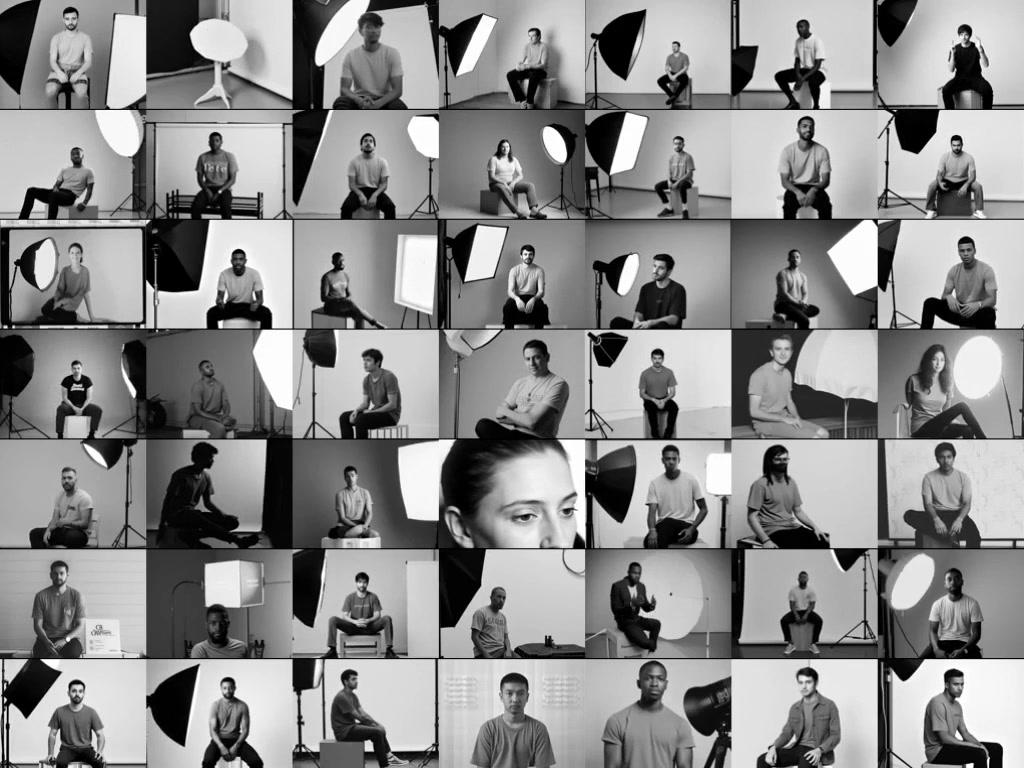
Shot 31. Forty-nine independent generations, placed as a grid in the edit.